Strangeways Prison

Strangeways prison, now known as HMP Manchester, is one of the places featured in my forthcoming novel, Danger by Association. It is a high-security category A prison.

In my latest novel, a rather unsavoury character called Maurice leaves the prison after serving a five year sentence. Maurice is then released back into a society, which isn’t very accepting of people like him.

For this article I thought I would give some background to the prison, which dates back to the nineteenth century and is a rather imposing building.

Strangeways 2

The building itself is Grade II listed, and its construction was completed in 1869. The original design was for the prison to house 1,000 inmates. It has walls which are 16 feet thick and were designed to be impenetrable. The ventilation tower, shown in the background of the picture, is a well-known landmark, which is often mistaken for a watchtower.

The design of the prison is based on a panopticon. This is a type of building designed by Jeremy Bentham, an English philosopher, in the 18th Century. A panopticon building is in the shape of a star. It has an inspection house or watchtower at its centre with wings branching off from the central area. The idea of this concept was for inmates to be observed without them always being aware of the fact that they are being watched.

Strangeways has ten wings, which branch out from two blocks. The diagram below shows the largest of the two blocks, which houses six wings.
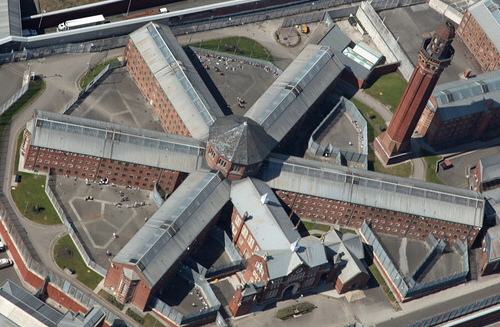
Strangeways Aerial View

Strangeways housed both male and female prisoners until 1963, but it is now a male only prison. It currently holds over 1200 hundred prisoners, and began taking remand prisoners in 1980. The name ‘Strangeways’ originates from the Anglo-Saxon word Strang gewoesc, which means, ‘a place by a stream with a strong current’.

Until 1964, executions were carried out at Strangeways. It had an execution room and a cell for the condemned prisoner as well as a permanent gallows. Between 1869 and 1964, 100 people were executed at Strangeways including the hanging of James Inglis. This was recorded as the world’s quickest hanging, and took just seven seconds.

The Strangeways Prison Riot – 1990

Prisoner protests about the conditions within the prison led to the riots of 1990. At that time, over 1600 prisoners were being held in a prison designed to house 1000 prisoners. The riot began in the prison chapel, but soon spread to other areas of the prison.

The riot lasted 25 days and prisoners were famously captured staging a rooftop protest. During the riot one prisoner was killed, and one prison officer died of a heart attack. Injuries were sustained by 147 prison officers and 47 prisoners. The total cost of repairing the damage to the prison was £90 million. Prisoners across the country responded by carrying out further disturbances in a number of other prisons.

Following the riots, the Government held a public enquiry. The outcome was for a major reform of the prison system. Strangeways was closed while substantial repairs and modernization took place. It re-opened in 1994 when it was renamed, HMP, Manchester. It now houses over 1200 male prisoners.

——————

Announcing my Latest Novel – Danger by Association

I can now announce that my latest novel ‘Danger by Association’, book 3 in the Riverhill Trilogy, is available for pre-order on the Amazon Kindle. Here are the links:

UK: http:/www.amazon.co.uk/dp/B01FE2A2BU.

US: http:/www.amazon.com/dp/B01FE2A2BU.

I am also thrilled to reveal the cover for ‘Danger by Association’. It is the work of talented book cover designer, Chris Howard, and I think it is his best one yet.

The image captures the exact mood I was looking for, and features our feisty heroine, Rita, complete with fiery red hair to match her temperament. Also, the colouring conveys the theme of danger, even in a thumbnail size. When you view the book cover in full size, you can see that bullets form a lot of the background image.

If you are interested in Chris’s work, he can be contacted at: blondesign@gmail.com.

Here is the cover image with the book blurb below:

Danger

Book Blurb

Rita has been avoiding Manchester; it brings back too many bad memories. She still has harrowing flashbacks of ruthless gangster, Leroy, and the death of a loved one. It takes the wedding of her brother, John, to persuade her to return. She agrees, on the condition that she steers clear of the Riverhill estate and Leroy’s family.

When her son, Daniel, is placed in danger, Rita is lured back to the Riverhill where she confronts those she believes responsible. She receives support from an unlikely source who promises information subject to terms. Realising that she needs help to act on that information, Rita turns to her brother, John.

But John works for the law. And he will have to go against everything he believes in if he agrees to embark on a maverick mission to help save his sister’s son.

—————-

‘Danger by Association’ is scheduled for publication on 24th June. I will be making further announcements regarding promotions and other activities via this blog as we draw nearer to publication date.

—————-

What is a Sink Estate?

The two housing estates, which form the main settings for my Riverhill Trilogy, are what are often described as sink estates. These are the Riverhill Estate and the Buckthorn Estate. In the lead up to the release of the third book in the trilogy, ‘Danger by Association’, I thought I would give some background relating to sink estates and describe how they earned the label.

Sink

The name sink estate is usually given to British council housing estates in deprived, urban areas. This type of estate often has high levels of crime although this isn’t necessarily a characteristic of such estates.

There are various theories as to how the name sink estates originated, and it is believed that it was probably a label given by the media. It came into use in the 1980s although this type of estate existed before then. Tony Blair famously used the term sink estates in a 1998 speech when he referred to ‘so-called sink estates’.

One of the theories is that the tag relates to the term, ‘behavioural sink’, which was used by ethologist John B Calhoun to describe the breakdown in behaviour resulting from overcrowding. He used rats and mice to conduct experiments on overcrowding and published a report in the Scientific American weekly newspaper in 1962 based on his findings.

Estate

There is a belief that sink estates were created by the right to buy scheme that existed under Margaret’s Thatcher’s conservative government of the 1980s and 1990s. Residents on the more popular council estates were most likely to take advantage of the scheme, and also most likely to qualify for mortgages.

On the other hand, in areas with high levels of unemployment and high crime rates, residents were unlikely or unable to purchase their council properties. At that time, there were cutbacks on council spending for housing improvements. Therefore, the less popular areas became increasingly run-down, and their residents became more isolated from the rest of society.

On the worst estates, crime is a way of life. It happens openly and residents are often frightened of reporting it to the police because of reprisals. Many also turn to crime to boost their income as a result of a lack of employment opportunities.

The word ‘sink’ itself also has various other negative connotations:Down

  • Sink or swim
  • To descend or plunge as in sinking to lower depths
  • To decline in value
  • To submerge or go under
  • To deteriorate in health

It is often difficult for residents of these estates to break away as behaviour patterns pass from generation to generation. Moreover, residents may have difficulty finding work because of employer pre-conceptions relating to certain areas.

I am making good progress with ‘Danger by Association’ and should be on schedule for a June launch. More news will follow.

——————–